Standard air purifier room ratings are designed for human bedrooms with minimal dust. They are not designed for a bird room full of powder down or a rabbit area with hay dust.
To protect a “Sentinel” species, you must ignore the “Square Footage” on the box and calculate the CADR-to-Volume Ratio.
1. The Standard: 5x ACH
In a standard home, 2 air changes per hour (ACH) is normal. For sensitive species, we aim for 5x ACH.
- Why 5? At 5 air changes per hour, the air is scrubbed every 12 minutes. This is the threshold where particulate “spikes” (like from a bird flapping its wings or a rabbit jumping in hay) are neutralized before they can cause respiratory inflammation.
2. The Manual Math (Step-by-Step)
To find out if your air purifier is strong enough, you need three numbers:
- Room Volume ($V$): Length × Width × Height (in feet).
- The Unit’s CADR ($C$): Found on the box (usually the “Smoke” rating).
- The Goal: 5 Air Changes per Hour.

Example Calculation:
If you have a 10ft x 12ft room with 8ft ceilings:
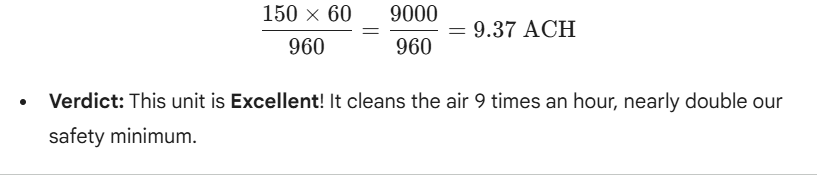
- Volume: $10 \times 12 \times 8 = 960 \text{ cubic feet}$.
- Your Purifier: Let’s say it has a CADR of 150.
- The Math:
3. The Quick-Reference CADR Guide
If you don’t want to do the math, use this “Sentinel Safe” cheat sheet for a standard 8ft ceiling:
| Room Size | Recommended CADR (Smoke) | Species Focus |
| Small (8′ x 10′) | 110+ | 1 Rabbit or Small Bird |
| Medium (12′ x 12′) | 200+ | Multi-bird or High-dust Hay |
| Large (15′ x 20′) | 400+ | Aviaries or Large Living Areas |
⚠️ The “Real-World” Reduction Factor
In 2026, we must account for Filter Loading.
Because bird dander and hay dust are “sticky” and “heavy,” they clog filters faster than household dust.
The Sentinel Rule: Always add a 20% safety buffer to your calculation. If your math says you need a CADR of 100, buy a unit with at least 120. This ensures that even when the filter is 50% dirty, your pet is still getting their 5x air changes.

Leave a Reply