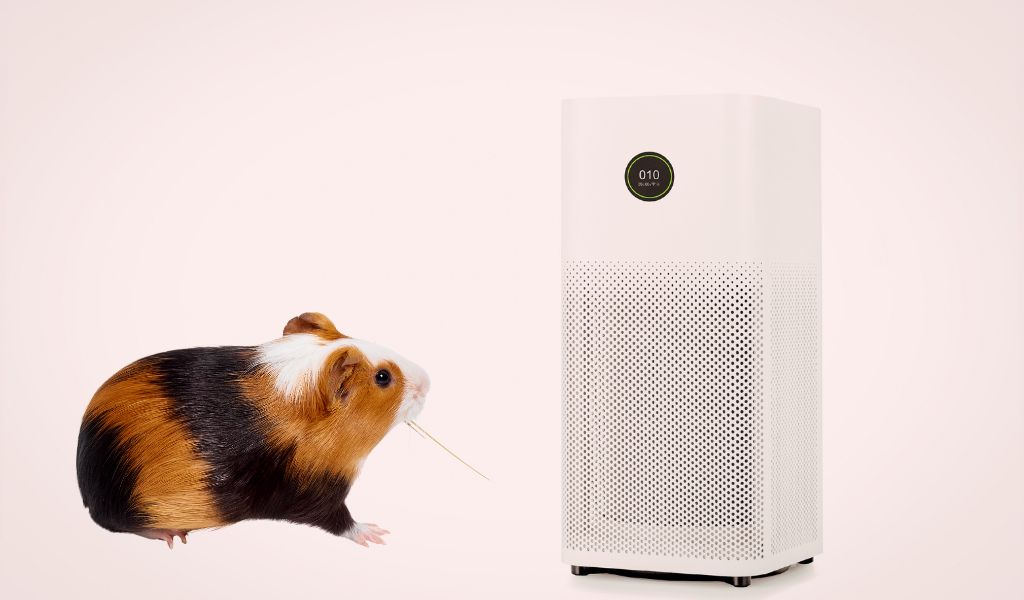
In the world of pet care, we often talk about the “canary in the coal mine.” But in 2026, your living room is the coal mine, and your rabbit, guinea pig, or chinchilla is the sentinel.
While humans might notice a “stuffy” room or a bit of dust, for a small mammal, poor indoor air quality (IAQ) isn’t just a nuisance—it’s a physiological crisis. To protect them, we have to look past the “pet hair” and look at the anatomy of how they breathe.
1. The “Ground-Level” Trap
Most air quality advice is written for humans who breathe at a height of 5 to 6 feet. Your small pets live just 2 to 6 inches off the floor.
Physics dictates that indoor pollutants are not evenly distributed. Heavy particulates, ammonia fumes from bedding, and settled PM2.5 (fine dust) congregate in the “boundary layer” near your flooring. While you are breathing the relatively clean air in the middle of the room, your guinea pig is living in a concentrated zone of floor-level sediment.
2. Obligate Nasal Breathers: A Single Point of Failure
Rabbits and guinea pigs are obligate nasal breathers. Unlike dogs, who can pant to bypass nasal congestion, or humans, who can breathe through their mouths, these small mammals must breathe through their noses.
- The Risk: If microscopic hay dust or dander causes inflammation in the narrow nasal passages (Rhinitis), the animal cannot simply “switch” to mouth breathing.
- The Result: Nasal blockage leads to increased respiratory effort, heart strain, and the fast-tracking of bacteria like Pasteurella (Snuffles) into the lower lungs.
3. High Metabolic Rates & Lung Volume
A rabbit’s heart beats between 130 and 325 times per minute. To support this intense metabolic demand, their respiratory systems work at a much higher “exchange rate” than ours.
Because they process more air per gram of body weight than a human, they also inhale a higher dose of toxins in the same amount of time. Whether it’s VOCs from a new carpet or the scent from a “pet-safe” candle, their threshold for toxicity is significantly lower than yours.
4. The Absence of Septa: Why Pneumonia Spreads
One of the most “boring” but critical facts about rabbit and guinea pig lungs is the absence of septa between lung lobes.
In humans, if one part of the lung gets an infection, the body can often localize it. In small mammals, the lack of internal walls means that pneumonia can become generalized across the entire lung field almost instantly. This is why a “slight sneeze” on Monday can become a terminal diagnosis by Wednesday.
Sentinel-Approved Purifiers for Birds/Small Furries
🛡️ The Sentinel Strategy: Immediate Actions
Knowing this anatomy, your filtration strategy must change:
- Elevate the Intake: Don’t just put an air purifier in the room; ensure the intake is positioned to pull air from the “pet zone” (floor level) without creating a direct draft on the cage.
- Scrub the Ammonia: Standard HEPA filters do nothing for urine fumes. You need a unit with pelletized activated carbon to chemically neutralize ammonia before it irritates the nasal mucosa.
- Manage the “Hay Cloud”: Hay is the #1 respiratory irritant for pocket pets. Always shake out hay in a separate room or near a high-CADR (Clean Air Delivery Rate) purifier to catch the “bloom” of dust.
📊 Comparison: Human vs. Small Pet Respiratory Intensity
This data explains why a “dusty” room feels like a mild annoyance to you, but a high-speed toxic intake for your pet.
| Species | Resting Breaths Per Minute | Max Breathing Rate | Vulnerability Level |
| Human (Adult) | 12 – 16 | 45+ (during exercise) | Moderate (Height protects us) |
| Rabbit | 30 – 60 | 120+ (when stressed) | Critical (Obligate nasal breathers) |
| Guinea Pig | 40 – 125 | 150+ | High (Low floor-level breathing) |
| Chinchilla | 40 – 80 | 100+ | High (Destroyed by pumice dust) |
| Hamster | 40 – 100 | 200+ | Extreme (Highest heart/breath ratio) |
Why these numbers matter for Air Quality:
- The “Intake” Multiplier: A Guinea pig at rest takes nearly 10 times as many breaths as a human in the same 60 seconds. This means they are effectively “sampling” the pollutants in the air (PM2.5, VOCs, ammonia) at an accelerated rate.
- The 6.3% Scaling Rule: While all mammals have a lung volume that is roughly $6.3\%$ of their body weight, the Tidal Volume (the amount of air per breath) in small mammals is much smaller. To get enough oxygen, they must breathe faster, making them more susceptible to “biological spikes” in air pollution (like when you shake a bag of hay).
- The Carbon Loading Gap: Because these pets breathe so frequently, they have a higher cumulative exposure to Ammonia gas from their bedding. If your air purifier doesn’t have at least 1lb of pelletized carbon, it won’t be able to keep up with the chemical “loading” these fast-breathing pets require.
Conclusion: The 3-Step Respiratory Defense Plan
If your small pet is a sentinel for air quality, your job is to create a “filtered sanctuary.” Based on the high respiratory rates we analyzed, a standard house-cleaning routine isn’t enough. You need to tackle the problem at the source, in the air, and on the floor.
Step 1: Source Control (The Hay Problem)
Since hay is a biological necessity for rabbits and guinea pigs but a respiratory nightmare, you must switch to Dust-Extracted Hay.
- The 2026 Gold Standard: Look for brands like DustFreeHay or Happy Hay Co. that use specialized vacuum-extraction during the baling process.
- Pro-Tip: Never shake hay inside the cage. Do it over a trash can in a different room, then bring the “clean” flakes to your pet.
Step 2: Active Filtration (The “Pelletized” Rule)
Don’t be fooled by “Pet Pro” air purifiers that only have a thin sheet of carbon. For ammonia and hay odors, you need Pelletized Activated Carbon.
- Top Recommendation: The Rabbit Air A3 or MinusA2. These units are specifically engineered for high-dander environments and allow you to customize the filter for “Pet/Allergy” or “Odor/Toxin” focus.
- The Budget Alternative: The Winix 5500-2. It remains a 2026 favorite because it uses a true AOC (Advanced Odor Control) washable carbon filter that actually holds up against small pet musks.
Step 3: Floor-Level Maintenance
Since your pet lives in the “Boundary Layer” (the bottom 6 inches of the room), your vacuum choice is as critical as your air purifier.
- The Requirement: A Sealed HEPA Vacuum. If the vacuum isn’t “Sealed,” it simply sucks up hay dust and blasts the microscopic allergens back out the exhaust right into your pet’s face.
- The Pick: The Shark Navigator Lift-Away Deluxe (NV360). It features an “Anti-Allergen Complete Seal” at a mid-range price point, making it the best ROI for a multi-pet household.
🛑 The “Sentinel” Checklist: Is Your Room Safe?
- [ ] Intake Height: Is your air purifier 6–12 inches off the ground?
- [ ] Ozone Check: Is your unit “Ozone-Free” certified (CARB compliant)?
- [ ] Filter Status: Have you vacuumed your pre-filter in the last 7 days? (Hay dust clogs these 3x faster than human dust).
- [ ] Ammonia Test: Can you smell the litter box from the doorway? If so, your carbon filter is saturated and needs replacing.
🛠️ From Research to Action: Your Safety Toolkit
Now that you understand the “Why” behind small mammal respiratory vulnerability, use the resources below to engineer a safer environment.
📋 Step 1: Implement the Protocols
Deep-dive guides on managing the two primary threats in your pet’s “Breathing Zone”:
- [The Hay Dust Protocol]: Learn how to neutralize PM2.5 and PM10 spikes during feeding and cleaning.
- [The Ammonia Alert]: Strategies for using molecular filtration to stop NH3 gas at ground level.
🧮 Step 2: Calculate Your Needs
Don’t guess on hardware size. Use our technical calculator to find your room’s specific requirements:
- [Small Pet Air-Exchange Calculator]: Input your room dimensions to find your 6x ACH target.
🛡️ Step 3: Choose Verified Hardware
Avoid “Ozone Traps” and underpowered filters. We’ve audited the top units for 2026:
- [The 7 Best Air Purifiers for Rabbits & Guinea Pigs]: Our registry of hardware tested for hay-heavy environments.
- [The 2026 Zero-Ozone Registry]: The master list of UL 2998 and CARB-certified “Mechanical-Only” units.
Ready to upgrade your air? View the 2026 Sentinel-Approved Hardware Registry
About the Author: Steve Bell [Pure Pet Air]
Pet Environmental Health Specialist & Air Quality Researcher
Steve is the founder of Pure Per Air, a resource dedicated to the intersection of mechanical air filtration and avian/small mammal respiratory health.
After witnessing the impact of “unseen” indoor pollutants on sensitive species—from the powder down of African Greys to the hay dust sensitivities of senior rabbits—Steve spent years deconstructing the math behind CADR ratings, carbon weight, and ozone safety specifically for multi-pet households.
Unlike general home reviewers, Steve focuses on the “Ground-Level Gap”—the unique air quality challenges faced by animals that live in the bottom six inches of our homes. By combining HVAC technical standards with species-specific respiratory data, Steve provides pet parents with the data they need to build safe, “sentinel-first” environments.