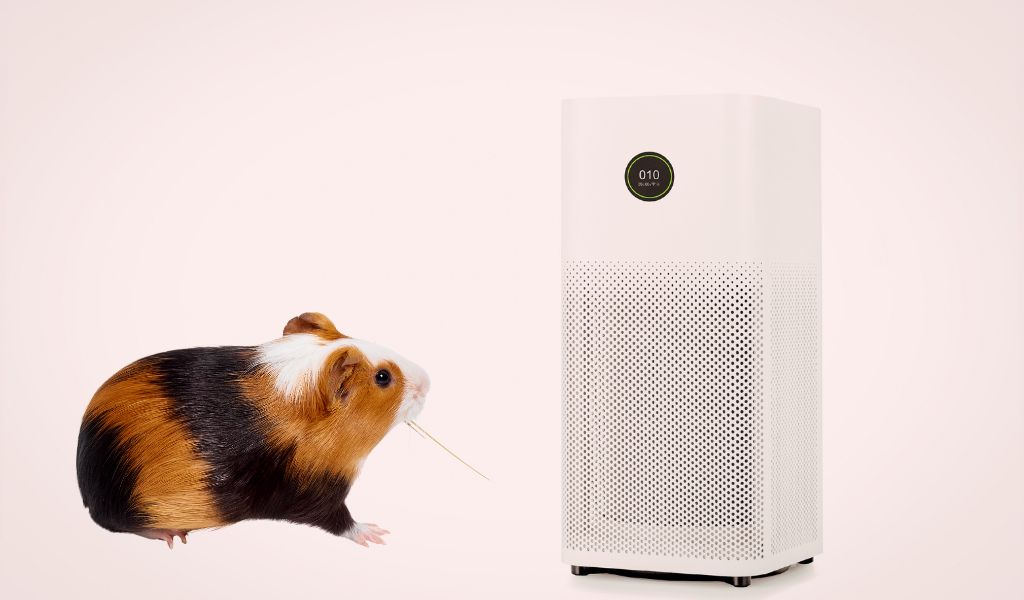
If you live with a rabbit, guinea pig, or chinchilla, you aren’t just managing pet dander; you are managing a biological dust factory.
As discussed in our [Small Furry Care Guide], air quality is a non-negotiable.
Rabbits and guinea pigs are “sentinel species,” meaning their delicate respiratory systems react to air pollution long before ours do. While constant access to forage is vital, the resulting particulate “spikes” from hay can lead to chronic inflammation and URI (Upper Respiratory Infections).
To protect your pet, you need a strategy that targets both visible fibers and microscopic PM2.5 dust. If you’re currently shopping for a solution, you can skip directly to our verified list of the [best air purifiers for rabbits and guinea pigs] to see which models passed our 2026 hay-loading tests.
Otherwise, read on to learn the three-step protocol for managing ground-level air quality in your pet room.
The “Ground-Level Gap”
Unlike humans who stand 5–6 feet tall, small mammals live in the bottom 12 inches of the room. This is where air is most stagnant and where heavy hay dust concentrates.
- The Problem: Most air purifiers pull air from the top or middle of the unit.
- The Protocol: For small furries, your air purifier must have bottom-loading intakes. If the intake vents start 6 inches off the floor, the unit will never catch the hay dust before it settles into your pet’s bedding.
The Anatomy of a Hay-Safe Filter
Not all HEPA filters can handle the “heavy loading” of a rabbit room. To manage a hay-heavy environment, your filtration must have three layers:
- The Mesh Pre-Filter (The “Shield”): This captures the large hay strands and “fluff.” Without a vacuumable mesh pre-filter, your expensive HEPA filter will clog and fail within 30 days.
- H13 True HEPA (The “Core”): This catches the invisible PM2.5 particles that trigger sneezing and “weepy eyes.”
- Activated Carbon (The “Sponge”): Essential for neutralizing Ammonia ($NH_3$) from litter boxes. Ammonia is a respiratory irritant that can “burn” the nasal passages of a guinea pig.
🌬️ Airflow Requirements: Overcoming “Hay-Loading”
When calculating air quality for small mammals, you cannot use the “Square Footage” listed on the air purifier box. Those ratings assume a human bedroom with minimal activity.
A rabbit or guinea pig room requires a higher CADR (Clean Air Delivery Rate) to overcome “Hay-Loading”—the rapid accumulation of fibers on the filter surface.
The 6x ACH Standard
While we recommend 5 Air Changes per Hour (ACH) for general pet safety, a hay-intensive room requires 6x ACH.
- The Reason: Because hay dust is “heavy,” it falls out of the air quickly. To catch it before it hits the floor, the air must be pulled through the filter every 10 minutes.
- The Math: If your room is 100 sq. ft., don’t buy a unit rated for 100 sq. ft. Look for a unit rated for at least 150–200 sq. ft. to ensure the motor has the “Static Pressure” to pull air through a dusty pre-filter.
Positioning for Maximum Flow
To ensure the airflow actually reaches your pet’s lungs at ground level, avoid “Corner Traps.”
- Don’t: Tuck the purifier behind a cage or in a corner where air becomes stagnant.
- Do: Place the unit in the “Flow Path” between the hay rack and the center of the room.
- The Sentinel Rule: Air should circulate across the litter box and into the purifier intake. If the air has to travel more than 8 feet from the hay source to the purifier, the hay dust will settle on the floor before it is ever filtered.
🧮 Calculation Tool: Not sure if your current unit is strong enough? Use our [Air-Exchange Calculator] and aim for the “High-Dust” setting (6x ACH) to see your room’s specific requirements.
The 3-Step Hay Management Routine
I. The “Shake-and-Settle” Zone
Never shake out hay flakes directly in the middle of the room.
- Action: Always load hay bags or racks directly next to the air purifier’s intake.
- Why: This creates a “directional pull,” sucking the immediate cloud of dust into the machine before it can disperse across the room.
II. Vertical Airflow Positioning
- Action: Place your air purifier on the floor, but elevated by 2 inches on a hard stand (if it has a bottom intake).
- Why: This prevents the unit from sucking up carpet fibers while ensuring it is perfectly leveled with the “dust zone.”
III. The “High-Fan” Feeding Time
- Action: Turn your purifier to “Max” or “Turbo” for 20 minutes whenever you add fresh hay or clean the litter box.
- Why: This manages the “particulate spike” that occurs during activity. You can return it to “Auto” or “Low” once the dust has settled.
🛡️ Top Recommended Units for Hay Dust (2026)
| Model | Why it works for Hay | The “Furry” Edge |
| Coway Airmega 250 | Top-Access Pre-Filter | You can slide the pre-filter out and vacuum it without opening the machine. |
| Levoit Core 600S | 360° Bottom Intake | Pulls dust from every direction at floor level; massive CADR for heavy hay users. |
| Winix 5500-2 | Washable Carbon Filter | The best at neutralizing heavy ammonia odors from rabbit litter. |
To see which of these units performed best in our long-term dander tests, read our full guide to the [best air purifiers for rabbits and guinea pigs]
⚠️ The “Chinchilla Warning” (Dust Baths)
If you own a Chinchilla, turn your air purifier OFF during the 15-minute dust bath.
- The Reason: Chinchilla dust is volcanic ash. It is so fine that it will bypass most pre-filters and “cement” your HEPA filter instantly.
- The Protocol: Wait 10 minutes after the bath for the dust to settle, then turn the purifier on “Turbo” to catch the remaining airborne particles.